Bayesian had a wind vulnerability its crew never knew about, the final report finds
The Marine Accident Investigation Branch concludes that the sailing yacht, at anchor with no sails set, could be knocked down by severe winds, and that the approved stability information given to the crew had never identified the risk. Seven people died when she sank off Sicily in August 2024.
The final official account of the loss of the sailing yacht Bayesian has been published, and its central finding is that the danger which sank her had never been written down for the people sailing her. The Marine Accident Investigation Branch, in its report of Thursday 19 November, found that with no sails set the yacht was vulnerable to being knocked down in severe winds, and that this vulnerability did not appear in the originally approved stability information available to the crew.
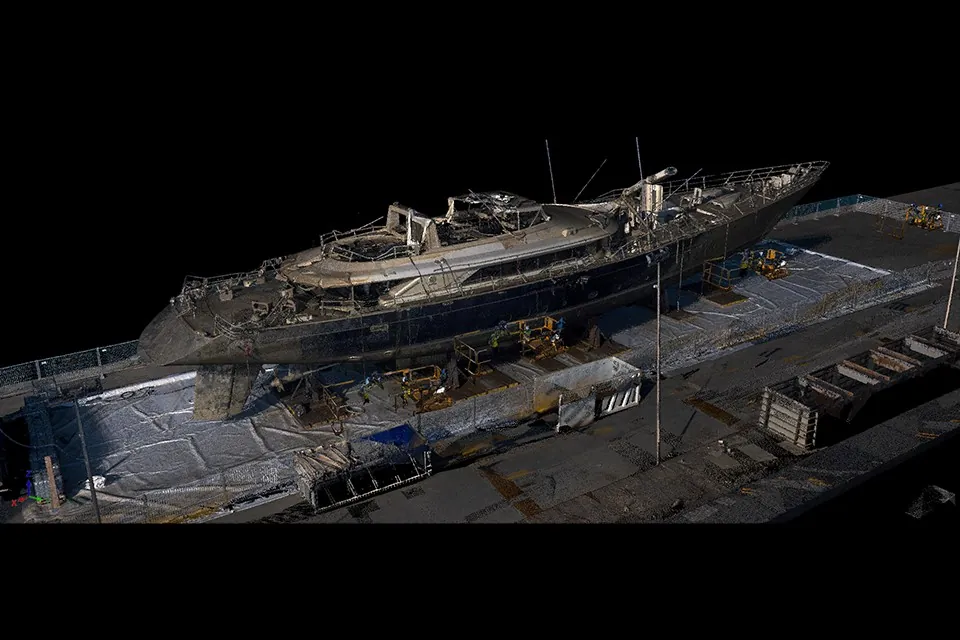
The accident itself took minutes. At 0406 on 19 August 2024, Bayesian lay at anchor half a nautical mile south-east of Porticello in Italy when a violent downburst of hurricane-force winds struck and threw her onto her starboard side. She could not right herself, flooded, and sank in 50 metres of water. Six guests and one member of the crew died. None of the liferafts on board inflated or released on its own; the crew freed one by hand, organised the survivors in the water and helped them into it, and a nearby vessel picked them up and carried them ashore. Fifteen people survived.
The Chief Inspector of Marine Accidents, Rob Loder, described how fast the weather turned that night: “In just 14 minutes, calm conditions had given way to winds of at least 68 knots, which in less than 15 seconds pushed the yacht onto its side.” On the underlying risk, he said the investigation had found “a vulnerability to high winds that was not recognised”, because her stability had never been evaluated while she rode at anchor with the sails furled. The winds that night, he added, had not been explicitly forecast either, so her crew were given no warning of what was coming.
Bayesian had a vulnerability to high winds that was not recognised.Rob Loder, Chief Inspector of Marine Accidents
The report explains the vulnerability in physical terms. How the yacht was loaded, the angle of the apparent wind and the position of her centreboard all bore on it, yet the combination had never been assessed in the condition in which she was lost, at anchor under no sail. The information environment around the crew fell short in a second way: the guidance provided to mariners did not give enough detail about what possible weather conditions could do to a vessel to support the decisions asked of them, and the forecast for the area, while predominantly correct, did not indicate that the predicted thunderstorms might produce downbursts.
Four recommendations follow. The Red Ensign Group is asked to study the vulnerabilities the report identifies and to amend its Yacht Code and associated guidance in response. The Maritime and Coastguard Agency is asked to rewrite the syllabus on which yacht masters are trained, adding the danger posed by downbursts and by sudden, severe gusts. The Met Office is asked to take up, inside the World Meteorological Organization, the question of how data services should present weather hazards that are unlikely to occur but devastating when they do. And the UK Hydrographic Office is asked to develop and update the guidance on extreme weather risks in its publications. A safety flyer for the yachting industry has been issued alongside the report.
The closing word in this case is about the gap between a risk that existed and a risk that anyone on board could have known about. The originally approved stability information available to the crew had not identified the vulnerability, and no stability check had ever covered her lying at anchor with the sails furled. In severe winds, in that condition, she was vulnerable to knockdown, and the assessment that would have shown it had never been done.
None to date. The Journal corrects errors promptly and transparently. Read our corrections policy.